Aug. 5, 2026
Inclusive Yoga Cueing: How to Teach Every Body Type
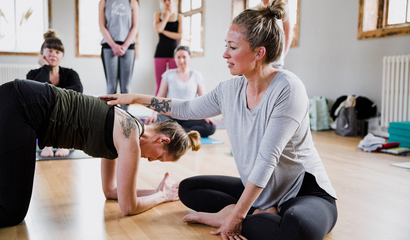
There’s been a noticeable rise in conversations around inclusive yoga cueing, and honestly, we love to see it!
At Heart + Bones, sustainable and inclusive teaching isn’t a trend. It’s foundational to how we think about movement. If you’re here, chances are you’re already curious about how to refine your cueing, support more bodies, and teach in a way that feels thoughtful rather than rigid.
If you prefer to watch instead of read, you can jump straight to the video below.
Or skim below for the key takeaways.
Either way, the question underneath all of this is the same:
How do we cue in a way that actually works for different bodies?
Heart + Bones Yoga Teacher Training
If you’re ready to go deeper into anatomy-informed, sustainable teaching, that’s exactly what we explore inside Heart + Bones—blending modern movement education with the mindful roots of yoga.
The Myth of the “Perfect” Yoga Cue
It’s completely normal to want to say the right thing in class. To offer alignment cues that feel clear, intelligent, and supportive. To land instructions that seem universally helpful.
But if you’ve been teaching for a while, you already know:
The perfect cue does not exist.
There isn’t one instruction that works for everyone. Not in Trikonasana, not in Warrior, not in Downward Dog. Not anywhere.
Bodies are dynamic. Bodies are different. They come with history, habits, injuries, strength, fear, resilience, and nervous systems that don’t respond the same way.
So eventually we arrive at a more useful question:
If there isn’t one cue to rule them all, what do we say instead?
In the video above, we narrow it down to three cues that, after decades of teaching and studying human movement, consistently work across styles, levels, and body types.
The Problem with Rigid Cueing in Yoga Classes
Many yoga teacher trainings—especially lineage-based ones—provide structured language to help teachers get started. That structure can be incredibly helpful in the beginning. It offers clarity. Confidence. A place to start.
There is nothing wrong with that.
But at some point, especially once you’ve taught enough classes with real humans, you start to notice something:
Those rigid cues don’t always land.
And that realization is a turning point.
Because from there, you have two choices:
- Double down on memorized scripting
- Or get curious about the body instead
For many teachers, that curiosity leads toward anatomy-informed teaching. Not to micromanage joints. Not to sound more advanced. But to understand human movement more clearly.
And interestingly, the more anatomy you understand, the less you feel the need to over-cue.
You begin to trust simpler, awareness-based language.
Which brings us to the three cues.
Three Inclusive Yoga Cues That Work Across Body Types
These cues are simple. Almost annoyingly simple. But they consistently support autonomy, accessibility, and sustainable movement.
1. “Notice how that feels in your body.”
Most traditional yoga cues are directive:
Lift.
Rotate.
Square.
Lengthen.
Directive language has its place. It’s useful. But when you follow it with:
“Notice how that feels in your body.”
You return power to the student.
Instead of:
Fit yourself into this shape.
It becomes:
Try this.
Feel it.
Decide what works.
This is where inclusive yoga cueing begins.
It reduces hierarchy. It builds interoception. It reminds students that their internal experience matters more than external appearance.
And in a world that constantly pulls us out of our bodies, that invitation is significant.
2. “Soften your jaw.” (or shoulders, forehead, belly…)
Tension patterns are nearly universal.
We clench when we concentrate. We grip when we balance. We brace when we’re trying to “get it right.”
When you say:
“Soften your jaw.”
“Relax your shoulders.”
“Notice if you’re holding tension.”
You’re not correcting alignment. You’re increasing awareness.
Layer one:
Oh. I was gripping.
Layer two:
Oh. That’s what release feels like.
This kind of cue works in any yoga style—strength-based, restorative, mobility-focused, slow flow—because it doesn’t assume a specific body shape or range of motion.
It simply invites awareness of habit.
3. “Feel your feet.”
Especially in standing poses.
When students are thinking about hips, arms, sequencing, balance, and what comes next, attention often floats upward.
“Feel your feet.”
This cue grounds.
It anchors awareness. It supports balance. It connects the nervous system to stability instead of striving.
Standing in your feet rather than hovering above them can change someone’s experience of Warrior or Triangle entirely.
And again, it works in every body.
You Don’t Need 100 Cues
Inclusive yoga teaching isn’t about eliminating anatomical language. It’s not about saying less just for the sake of minimalism.
It’s about saying what matters.
You can still cue femur rotation. You can still talk about scapular movement. Anatomy-informed teaching is part of sustainable movement.
But when those cues are layered with:
- Notice how it feels
- Soften
- Feel your feet
You create a class that is functional, inclusive, and grounded in awareness.
That’s when the movement becomes yoga.
Teaching Every Body Type Without Overcomplicating It
You don’t need a brand new script.
You don’t need to abandon your training.
You don’t need to become an anatomy professor.
You need curiosity.
You need humility.
You need to understand that bodies respond differently.
And you need cues that support autonomy rather than override it.
These three are a starting point.
Heart + Bones Yoga Teacher Training
If you’re ready to go deeper into anatomy-informed, sustainable teaching, that’s exactly what we explore inside Heart + Bones—blending modern movement education with the mindful roots of yoga.