April 20, 2026
How to Practice Bridge Pose for Stronger Glutes (Without Hurting Your Back)
Bridge Pose (Setu Bandha Sarvangasana) shows up in nearly every yoga class. It's accessible, requires no props, and targets muscles most people genuinely need to strengthen. Yet it's also one of the most commonly practiced poses in a way that irritates the lower back, strains the knees, or simply doesn't deliver on its promise.
A few targeted adjustments change that completely. This guide breaks down the anatomy of Bridge Pose, what actually happens in your body when you do it, and how to get your glutes doing the work they're supposed to do.
Why Glute Strength Matters in Bridge Pose
The glutes—the large muscles at the back of your pelvis—are among the strongest in the human body. Their primary job is to extend and rotate the hip joint, which means they're working every time you walk, climb stairs, or stand up from a seat.
They also serve as a support system for the lumbar spine. The lumbar spine is naturally mobile, which is useful, but that mobility needs a stable anchor. Strong, active glutes provide that. When they're not doing their job, the lower back tends to compensate. That compensation is often the reason Bridge Pose creates back discomfort rather than relieving it.
This is why learning to activate the glutes in Bridge Pose matters beyond the yoga mat. You're reinforcing a pattern the body can use everywhere.
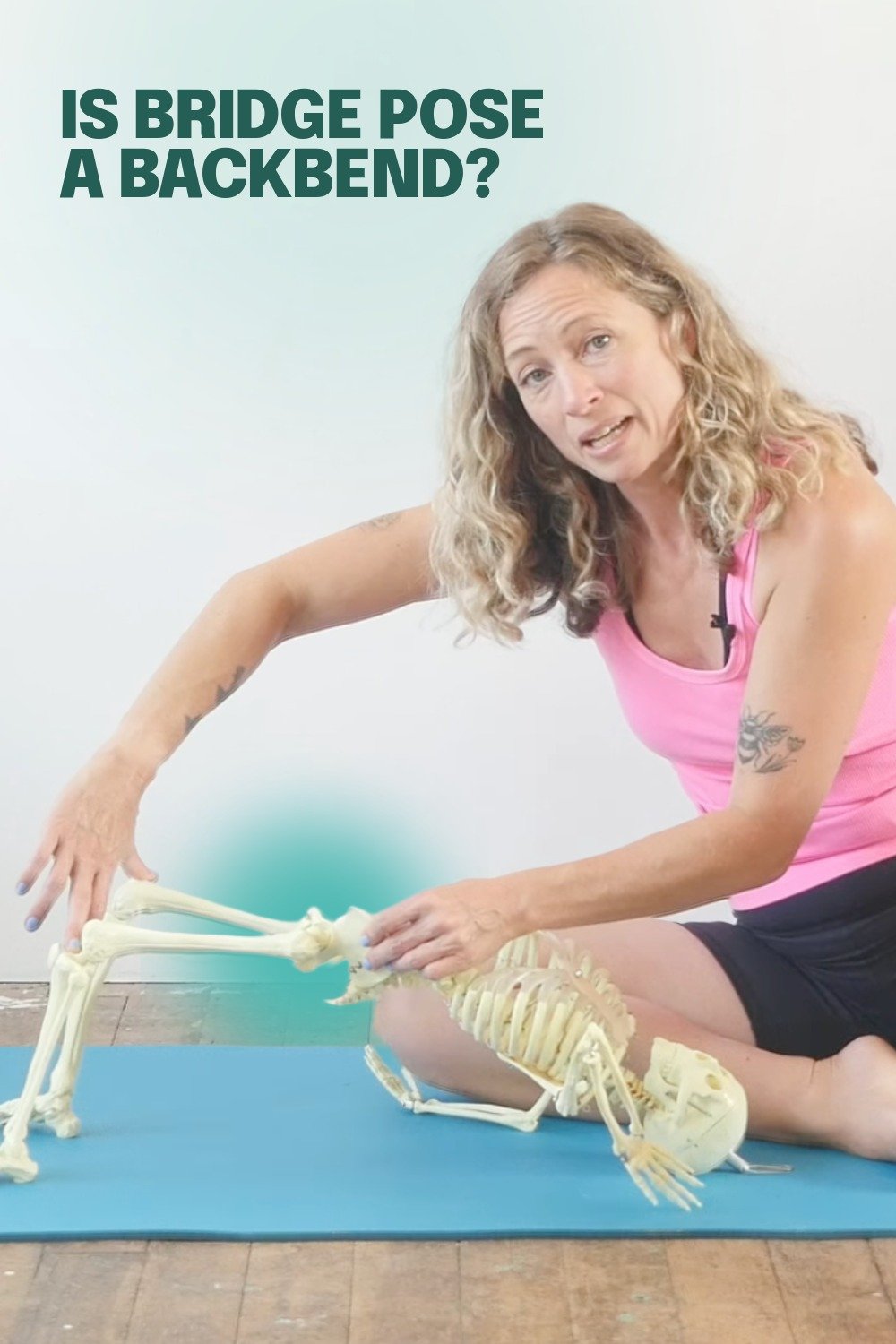
Is Bridge Pose a Backbend?
This is a more useful question than it might seem, because how you categorize the pose affects how you practice it.
Some teachers classify Bridge as a backbend because it involves hip extension—lengthening the front of the pelvis. But very little spinal extension is actually occurring, and the thoracic spine, by design, has limited capacity for extension anyway. The spinous processes of the upper thoracic vertebrae angle downward, which means there simply isn't much range of motion available there.
What tends to happen in practice is a hinge around the lower thoracic and lumbar vertebrae rather than an even, distributed arch through the whole spine.
Treating Bridge as a posterior chain strengthening exercise, rather than a backbend, leads to a more effective and safer practice. As tempting as it is to think about making an arch shape, your lower back will be happier if the goal is to lift the pelvis by pressing into the floor and letting the glutes do their job.
Common Cues That Work Against You
"Relax Your Glutes"
This cue has been common in yoga for a long time. From an anatomy standpoint, it doesn't hold up.
Relaxing the glutes during hip extension shifts the workload to neighbouring structures—the hamstrings, hip flexors, and lower back. None of these are better suited to stabilize the position. Active glutes support the SI joint, protect the lumbar spine, and keep the surrounding muscles from overworking.
If you're a yoga teacher and this cue is still in rotation, it's worth retiring.
"Squeeze" Your Glutes
Cueing a squeeze—which many people interpret as clenching—often pushes the hips too high and creates compression in the lower back rather than stability through the pelvis.
The more useful instruction is activation: engaging the glutes as a response to what the feet are doing, not as a forced isolated contraction. The distinction matters, and it changes how the pose feels.
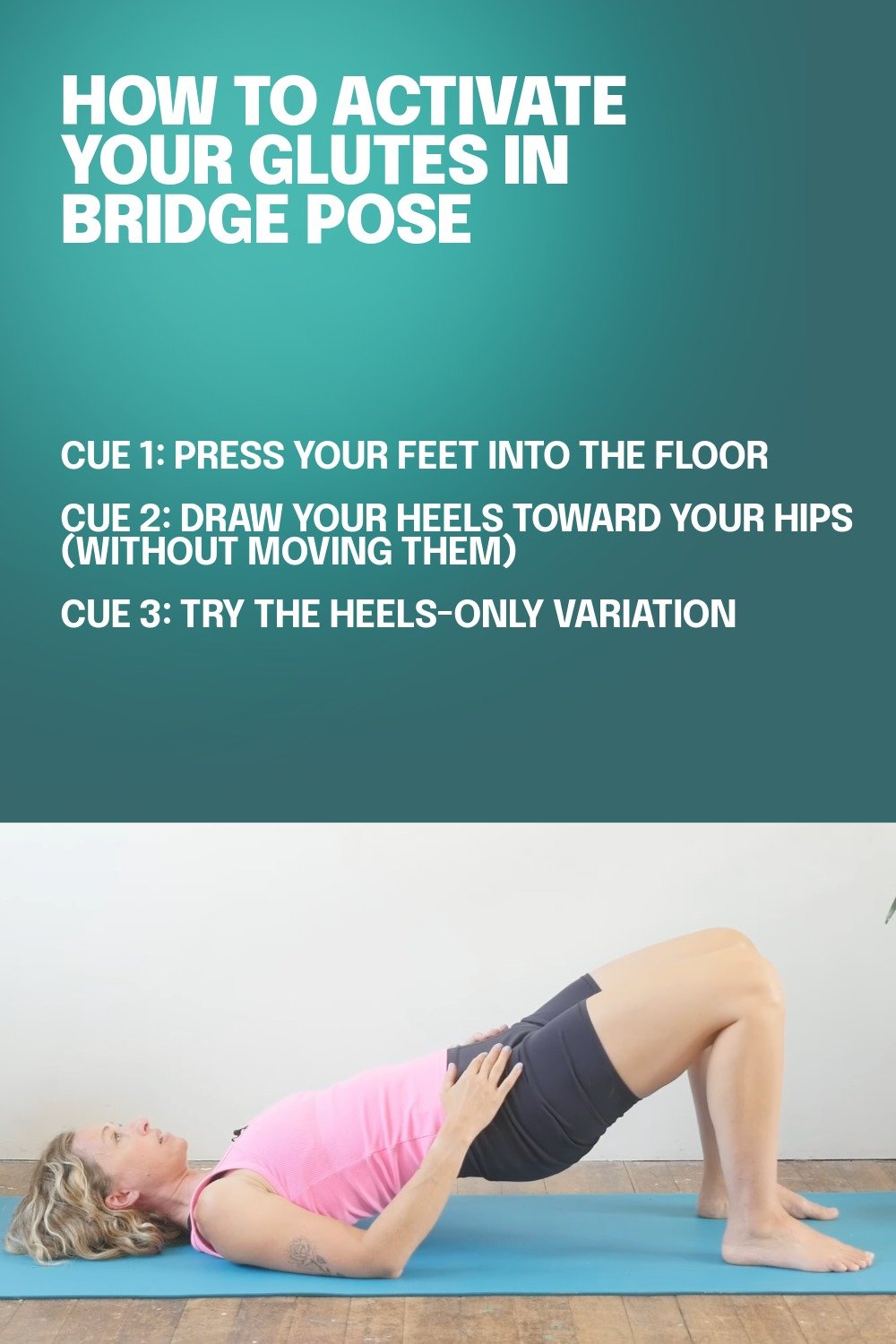
How to Activate Your Glutes in Bridge Pose
Cue 1: Press Your Feet Into the Floor
Start here. Pressing the feet firmly into the ground creates a chain reaction up through the legs that naturally invites the glutes to engage. You don't need to think about the glutes directly, the foot pressure does the recruiting.
This applies on the way down too. Most people release the effort the moment they start lowering. Keeping the feet pressing into the floor throughout the entire movement, up and down, is where the real glute work happens.
Cue 2: Draw Your Heels Toward Your Hips (Without Moving Them)
While pressing the feet down, add an isometric intention of pulling the heels toward the hips, without actually sliding them. This engages the hamstrings more deliberately, which often brings the glutes online as well.
Combined with the downward pressure of the feet, this dual-direction action tends to produce noticeably more posterior chain engagement than either cue alone.
Cue 3: Try the Heels-Only Variation
Lift the front of the foot so only the heels are in contact with the floor, then practice the lift from there. For many people, this variation shifts the activation further into the glutes without overloading them.
It doesn't work the same way for every body, so treat it as an experiment rather than a prescription.
How to Tell If Your Glutes Are Working
Place your fingers on your glutes before you lift. They should begin engaging as soon as your feet press down—before your hips leave the floor. If they feel inactive on the way up, return to the foot-pressure cue and see if that changes things.
Feeling the work mostly in your hamstrings is normal, especially when you're first learning to recruit the glutes more intentionally. The hamstrings and glutes work together here. With consistent practice, the brain builds a clearer motor pathway to the glutes, and the activation becomes easier to find.
Frequently Asked Questions
Should I squeeze my glutes in Bridge Pose? Squeezing in the sense of clenching often creates lower back tension and drives the hips higher than is useful. A better approach is activation through movement: press your feet into the floor and let the glutes respond to that action rather than forcing a contraction.
Why do I feel Bridge Pose in my hamstrings and not my glutes? This is very common. The hamstrings and glutes both contribute to hip extension, and the nervous system defaults to muscles it already recruits easily. Try the heel-drag cue—drawing the heels isometrically toward the hips while pressing down—or the heels-only variation to shift more of the emphasis toward the glutes.
Why does Bridge Pose hurt my lower back? Lower back discomfort in Bridge Pose usually comes from the lumbar spine doing work the glutes should be doing. Focus on pressing the feet into the floor to activate the glutes before and during the lift, and avoid pushing the hips higher than feels stable. The glutes are meant to be the primary movers here, not the lower back.
Is Bridge Pose good for people with weak glutes? Yes! When practiced with intention. Bridge Pose is one of the more accessible ways to begin building glute strength because it doesn't require standing balance or significant mobility. Start with small ranges of motion and focus on the quality of activation rather than how high the hips lift.
What is the difference between a glute bridge and Bridge Pose in yoga? The movement is essentially the same. Glute bridge is the term more commonly used in fitness and physical therapy contexts, while Bridge Pose is the yoga name. The anatomy-informed cues in this guide apply to both.